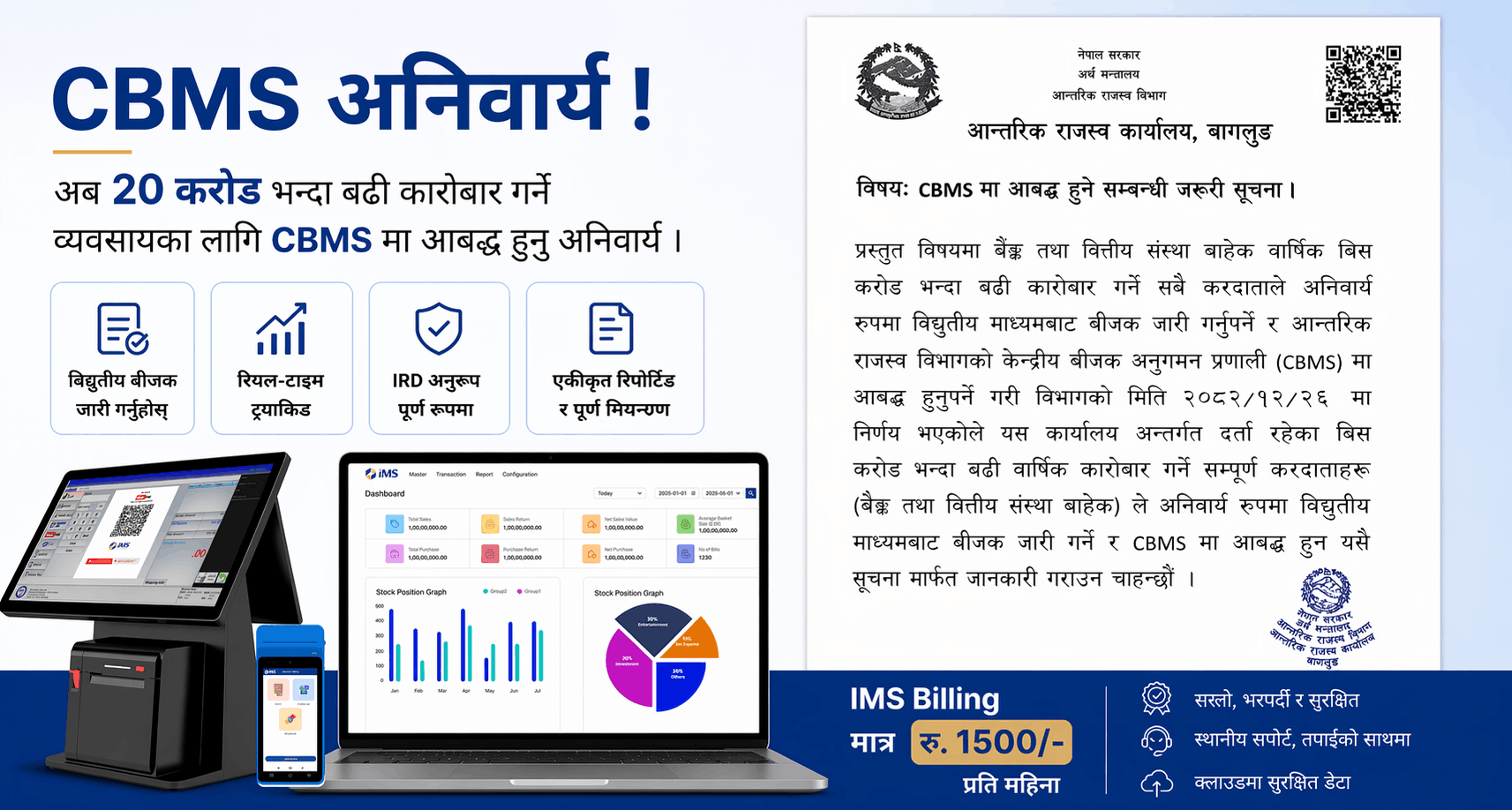
The Government of Nepal, through the Inland Revenue Department, has introduced an important change that directly affects high turnover businesses. According to the latest decision, all taxpayers except banks and financial institutions with turnover above NPR 20 crore must now use electronic billing systems and connect to the Central Billing Monitoring System CBMS.
The department implemented this decision on 2082/12 /26 to improve transparency, strengthen tax compliance, and move businesses toward a more modern and digital way of operating. Because of this change, businesses can no longer rely on manual billing and paper invoices.
What CBMS Means for Your Business?
CBMS allows the government to monitor invoices in real time, ensuring that all transactions are properly recorded and tracked. For businesses, this means greater accountability. At the same time, not following this requirement could lead to issues during audits and increase the risk of non-compliance.
With this change, going digital is no longer just an option, it has become a necessity. Businesses now need to adopt reliable systems that not only help them meet these requirements but also make their operations smoother and more efficient in the long run.
How IMS Billing Helps?
In this situation, having the right technology partner matters. IMS Billing helps businesses smoothly transition to digital billing by making them CBMS-ready. With features like electronic invoicing, real-time invoice tracking, and centralized control, IMS ensures that all billing processes are aligned with IRD requirements. Instead of managing multiple systems, businesses can handle everything from billing to reporting within one reliable platform.
One of the key advantages of IMS Billing is its accessibility. Starting at just NPR 1500 per month, it offers an affordable and reliable solution for businesses looking to comply with CBMS without heavy investment. For the value it provides, it’s a practical choice for businesses aiming to stay compliant and efficient at the same time.
As Nepal’s business environment continues to evolve, adopting solutions like IMS Billing not only helps in meeting regulatory requirements but also improves efficiency, accuracy, and overall business control.